I don’t have Gaddis, but will look for a copy.
I didn’t find anything posted here as “condescending.” On the contrary, my understanding of facts, AND the limits of those facts is greatly expanded. This group-think review of facts is exactly how we conduct major accident investigations offshore.
I would be surprised if all, including Perry and Joe, haven’t had their curiosity piqued by some of the contradictions in known, accepted, information. This is usually what happens in productive group exchanges.
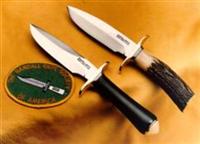
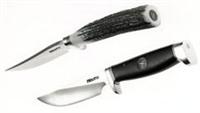
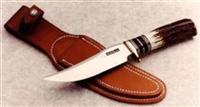
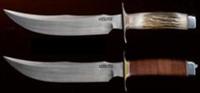
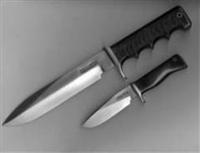
RMKs presumably with sheaths were with Mercury Astronauts by July, 1960 as per Shirra, in “Schirra’s Space.”
http://books.google.com/books?id=RLd_mS3acoUC&pg=PA68&lpg=PA68&dq=%22John+Glenn+Randall+knife%22&source=bl&ots=lhhr-uK9RB&sig=R-5OepuevdmfY9yZTXUmSNqQ-bo&hl=en&ei=0X3ATsbaEPLfsQKnwpDBBA&sa=X&oi=book_result&ct=result&resnum=4&sqi=2&ved=0CDoQ6AEwAw#v=onepage&q&f=false
------------------------------------------------------------------------------------------------------------
Below is a great timeline for Project Mercury. I think scanning this brings home the magnitude of the medical research side, the organization of which was presumably assisted by Lt. Col. Salvo.
http://www.astronautix.com/project/mercury.htm1960 July 12 - .
• Mercury astronaut desert survival training - . Nation: USA. Program: Mercury. The astronauts underwent a five and one half day course in 'desert survival' training at the Air Training Command Survival School, Stead Air Force Base, Nevada. The possibility of an arid-area landing was remote but did exist. So this training was accomplished to supply the astronaut with the confidence and ability to survive desert conditions until recovery. The course consisted of one and one half days of academics, one day of field demonstrations, and three days of isolated remote-site training. Survival equipment normally installed in the Mercury spacecraft was used to provide the most realistic conditions.




 Previous Topic
 Index
Index