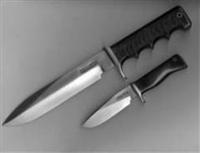
I often receive PMs and emails about what camera, lens, and lighting I am using to take photos, and this seemed like a good time to share some thoughts on this topic.
In terms of equipment, I use a Nikon D300 digital SLR with a Nikkor 60mm Micro lens, and a Lowel three-light set. I also use an ExpoDisc to set the white balance, which is fairly critical for digital photography. If white balance is "off," you generally notice a seemingly unnatural yellow, red, or blue hue in the resulting photos. I shoot in RAW, which is NEF for Nikon cameras that have this capability, and post-process my photos using Adobe Photoshop Lightroom, which is better known as simply Lightroom.
Why a macro lens? This specific one was bought about seven years ago, and has transcended four Nikon digital SLRs: D100, D200, D80, and D300. Most people think of macro lenses as simply the ability to focus at close range, but they offer more than that. (I should also point out that the advertised focusing range for SLR lenses is not from the lens to the object, but from the focal plane [where the film or sensor is in the camera, behind the lens] to the object.) A macro lens additionally provides correct perspective, meaning that objects that are straight or have straight lines appear straight, and not slightly curved or bent, and also the ability to use smaller apertures. Most lenses stop down to f/22. Macro lenses can typically stop down further. And, as the focusing range decreases, some allow you to stop down further, beyond the advertised minimum aperture. If you inspect the Exif data of the photo below, you'll see that it was shot at f/51 for three full seconds:

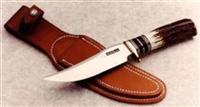
The advantage of a small aperture, of course, is to have a greater depth-of-field. The smaller the aperture, the greater the depth-of-field, and the greater the depth-of-field, more of the object, from front to back relative to the lens, will be in focus. Focusing distance also affects the depth-of-field, and the closer the focusing distance, the shallower the depth-of-field becomes, regardless of the aperture. The photo below takes advantage of depth-of-field to bring the entire object, from front to back, in focus:

About lighting, photography is all about light, and one's ability to capture it effectively. Everything else is a distant secondary concern, including equipment. Having multiple light sources is rather key, too. This helps to minimize or eliminate shadows. The placement of the lights are also key, and especially important for objects with Satin finishes. For objects with mirror-like surfaces, light placement is absolutely critical, and to a great extent, the background material that becomes visible on the mirror-like surface.
Other important factors include the background material, such as its color or texture, and composition. Something neutral is always best. And, just FYI, red is far from being neutral, yet we see it so often in photos, especially of firearms. About composition, photographing these objects dead-on, such as from the side, does very little to bring out any perception that they are 3D objects. Photographing from the front, or at a slight angle, can bring out a lot in an object:

In any case, I have documented some of my photography tips, as they pertain to firearms and knives, here:
http://lundestudio.com/phototips.html


 Previous Topic
 Index
Index